From Provider to Patient: Dr. Jennings’ Colon Cancer Story

​​​After decades of caring for patients with The Christ Hospital Health Network, it didn’t take long after his retirement for Michael Jennings, MD to find himself playing the role of the patient. As an internal medicine specialist, he encouraged patients to keep up with routine screenings for the prevention and early detection of certain diseases such as colon cancer – a lesson that proved all too real just a few months into his retirement.

During a routine colonoscopy, Dr. Jenning’s gastroenterologist found a lesion in the lower part of his colon, which turned out to be colon cancer. Fortunately, the early detection increased the chances for successful treatment. For that, he turned to his long-time colleague, Janice Rafferty, MD​, the Chief of Colorectal Surgery and Director of Surgical Oncology Services at The Christ Hospital Health Network.

Dr. Rafferty performed a minimally invasive robotic-assisted surgery to remove the cancer, and it wasn’t long before Dr. Jennings was back on the golf course and enjoying his retirement. Hear all about Dr. Jennings’ story and his care from Dr. Rafferty and her team in their own words.

Dr. Jennings’ Story

Dr. Jennings: I retired in January of 2025, so the perfect day up until my diagnosis of colon cancer was going to the golf course and playing nine holes.

So, my story relative to colon cancer really starts about 40 years ago when I was diagnosed with inflammatory bowel disease. I’ve been getting a yearly colonoscopy starting about 10 years after the onset of my diagnosis. And six months into my retirement, I showed up feeling great, anticipating no problems. And to my surprise, Dr. Chokshi, who did my procedure, found that I had cancer in my colon.

The gastroenterologist and I had a very short conversation about who I would see. He knows that I've spent my career at Christ Hospital. He knows that Doctor Rafferty and I have worked together. He also knows, as I know, that she's the best.
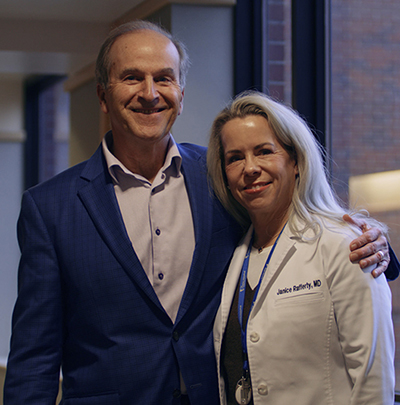
Dr. Michael Jennings and Dr. Janice RaffertyDr. Rafferty: He's done everything right. You know what? And even despite that, these things happen. And in Dr. Jennings’ case, we went straight to surgery because of the very early stage and the high rate of curability of this problem.

When we use robotics, we're essentially doing the same operation we did in the old days through smaller incisions, so the patients have less pain, less intestinal slowdown, earlier return to normal activities, less blood loss, lower infection rate.

Dr. Jennings: Yeah, I really had a wonderful post op course. I literally left the hospital within 48 hours of my surgery. And thankfully, even up to this day, I've had no complications or problems.

Now, this is not just about the surgeon. It's about the technology. It's about the care before surgery, the care after surgery, and the care in the office. And I knew that Doctor Rafferty had the best team assembled to take care of my problem.

Dr. Rafferty: And it was an honor to be a part of that team. It truly was.

Frequently Asked Questions About Colon Cancer

Q: Who should be regularly screened for colon cancer?
A: Doctors recommend regular screening for everybody 45 years and older. However, you may want to start younger if you have risk factors such as family history, a positive test for a mutated gene that increases risk, or related diseases such as Crohn’s disease or ulcerative colitis. Ask your primary care doctor to be sure what’s right for you.

Q: Should I do a home screening or have a colonoscopy?
A: Many doctors will tell you that all screenings are better than nothing. Home screenings are convenient and have a high rate of accuracy for detecting colon cancer. However, a colonoscopy is still the gold standard with an even higher rate of accuracy, plus the added benefit of prevention. A gastroenterologist can remove non-cancerous polyps during the procedure that could one day develop into cancer if not removed.

Q: What are the symptoms of colon cancer?
A: Colon cancer can develop and be diagnosed and treated long before the appearance of any symptoms. However, it’s good to know the symptoms and talk to your doctor if you experience them:

  • Abdominal pain

  • Blood in your stool or on toilet paper

  • Change in appetite or taste

  • Change in the shape or formation of your stool

  • Fatigue

  • Sudden weight loss

Janice Rafferty, MD

​​​​Janice Rafferty, MD, is the Chief of Colorectal Surgery and Director of Surgical Oncology Services at The Christ Hospital Network. She has over 25 years of experience diagnosing and treating complex colorectal conditions.

From Provider to Patient: Dr. Jennings’ Colon Cancer Story After decades of caring for others, Dr. Michael Jennings found himself playing the role of patient after a colon cancer diagnosis, for which he turned to a long-time colleague for care.

​​​After decades of caring for patients with The Christ Hospital Health Network, it didn’t take long after his retirement for Michael Jennings, MD to find himself playing the role of the patient. As an internal medicine specialist, he encouraged patients to keep up with routine screenings for the prevention and early detection of certain diseases such as colon cancer – a lesson that proved all too real just a few months into his retirement.

During a routine colonoscopy, Dr. Jenning’s gastroenterologist found a lesion in the lower part of his colon, which turned out to be colon cancer. Fortunately, the early detection increased the chances for successful treatment. For that, he turned to his long-time colleague, Janice Rafferty, MD​, the Chief of Colorectal Surgery and Director of Surgical Oncology Services at The Christ Hospital Health Network.

Dr. Rafferty performed a minimally invasive robotic-assisted surgery to remove the cancer, and it wasn’t long before Dr. Jennings was back on the golf course and enjoying his retirement. Hear all about Dr. Jennings’ story and his care from Dr. Rafferty and her team in their own words.

Dr. Jennings’ Story

Dr. Jennings: I retired in January of 2025, so the perfect day up until my diagnosis of colon cancer was going to the golf course and playing nine holes.

So, my story relative to colon cancer really starts about 40 years ago when I was diagnosed with inflammatory bowel disease. I’ve been getting a yearly colonoscopy starting about 10 years after the onset of my diagnosis. And six months into my retirement, I showed up feeling great, anticipating no problems. And to my surprise, Dr. Chokshi, who did my procedure, found that I had cancer in my colon.

The gastroenterologist and I had a very short conversation about who I would see. He knows that I've spent my career at Christ Hospital. He knows that Doctor Rafferty and I have worked together. He also knows, as I know, that she's the best.

Dr. Michael Jennings and Dr. Janice RaffertyDr. Rafferty: He's done everything right. You know what? And even despite that, these things happen. And in Dr. Jennings’ case, we went straight to surgery because of the very early stage and the high rate of curability of this problem.

When we use robotics, we're essentially doing the same operation we did in the old days through smaller incisions, so the patients have less pain, less intestinal slowdown, earlier return to normal activities, less blood loss, lower infection rate.

Dr. Jennings: Yeah, I really had a wonderful post op course. I literally left the hospital within 48 hours of my surgery. And thankfully, even up to this day, I've had no complications or problems.

Now, this is not just about the surgeon. It's about the technology. It's about the care before surgery, the care after surgery, and the care in the office. And I knew that Doctor Rafferty had the best team assembled to take care of my problem.

Dr. Rafferty: And it was an honor to be a part of that team. It truly was.

Frequently Asked Questions About Colon Cancer

Q: Who should be regularly screened for colon cancer?
A: Doctors recommend regular screening for everybody 45 years and older. However, you may want to start younger if you have risk factors such as family history, a positive test for a mutated gene that increases risk, or related diseases such as Crohn’s disease or ulcerative colitis. Ask your primary care doctor to be sure what’s right for you.

Q: Should I do a home screening or have a colonoscopy?
A: Many doctors will tell you that all screenings are better than nothing. Home screenings are convenient and have a high rate of accuracy for detecting colon cancer. However, a colonoscopy is still the gold standard with an even higher rate of accuracy, plus the added benefit of prevention. A gastroenterologist can remove non-cancerous polyps during the procedure that could one day develop into cancer if not removed.

Q: What are the symptoms of colon cancer?
A: Colon cancer can develop and be diagnosed and treated long before the appearance of any symptoms. However, it’s good to know the symptoms and talk to your doctor if you experience them:

  • Abdominal pain

  • Blood in your stool or on toilet paper

  • Change in appetite or taste

  • Change in the shape or formation of your stool

  • Fatigue

  • Sudden weight loss

/Pages/Healthspirations/Doctor-Jennings-Colon-Cancer.aspx
The Christ Hosptial